Forge of Traders Review: Plans, Rules, and How It Compares
 Forge of Traders
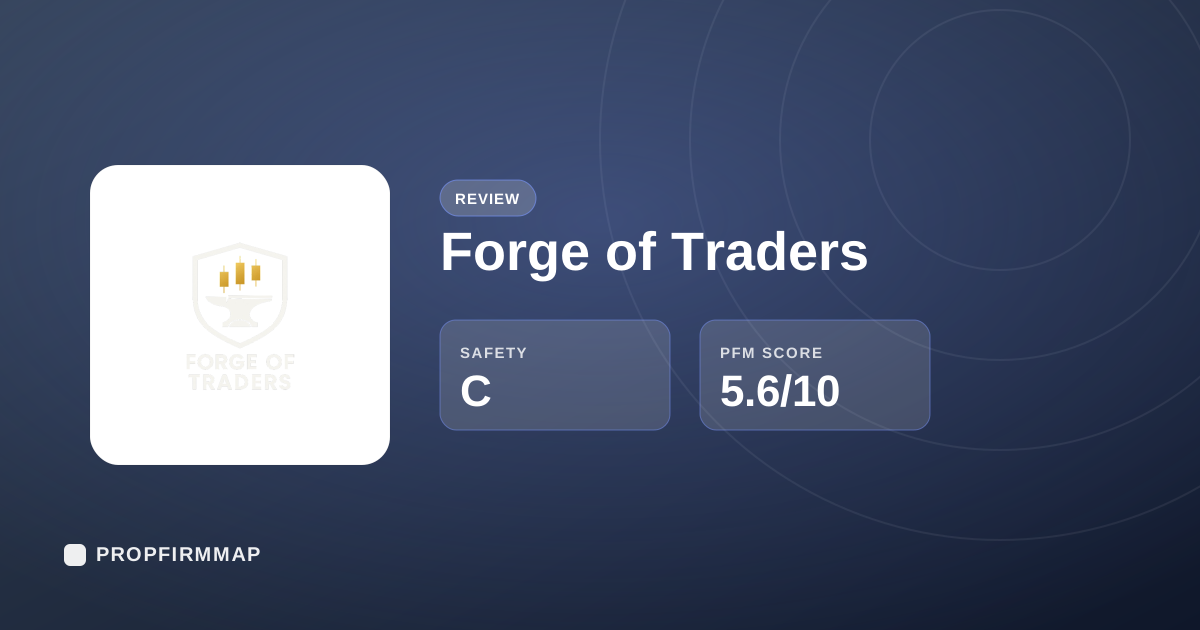
Forge of Traders is a CFD prop trading firm operated by PlanetPulse Holdings LTD and based in Nicosia, Cyprus. It offers four routes to a funded account: Instant Funding, plus One, Two and Three-Phase evaluations, sized from $5,000 up to $500,000. Traders get an 80% base profit split that can be raised to 90% through a paid add-on, a 10% static maximum drawdown anchored to the initial balance, and a daily drawdown measured on end-of-day balance rather than intraday equity. The firm quotes leverage of 1:30 on FX and 1:20 on commodities and indices, and lists FX, metals and indices CFDs as its tradable universe. Its established date is not published, so PropFirmMap records it as unknown rather than estimating one.
Plans and pricing
Forge of Traders splits its catalogue into four programs. The One-Phase Challenge asks for a single 10% profit target. The Two-Phase Challenge splits the requirement into 8% and then 5%. The Three-Phase Challenge spreads it across 8%, 5% and 3%, and carries the lowest entry price in the catalogue. Instant Funding removes the evaluation entirely and has no profit target at all.
The table below shows the $100,000 tier across all four programs, plus the cheapest entry point the firm sells, as recorded on the Forge of Traders program and checkout pages.
| Program | Account size | Price | Profit target | Daily drawdown | Max drawdown |
|---|---|---|---|---|---|
| 1-Phase Challenge | $100,000 | $475 | 10% | 5% | 10% |
| 2-Phase Challenge | $100,000 | $465 | 8% then 5% | 5% | 9% |
| 3-Phase Challenge | $100,000 | $345 | 8%, 5%, 3% | 5% | 10% |
| Instant Funding | $100,000 | $3,499 | None | 4% | 10% |
| 3-Phase Challenge | $5,000 | $26 | 8%, 5%, 3% | 5% | 10% |
Three paid add-ons are offered at checkout, each priced as a percentage uplift on the challenge fee: Insurance at plus 30%, Profit Share at plus 20% (this is the add-on that lifts the split from 80% to 90%), and Swing Trading at plus 30% (required to hold positions over the weekend). Failed challenges can be reset without limit at 90% of the original challenge price. The minimum payout threshold is $50.
Rules summary
The drawdown model is the clearest part of the offer. The overall limit is static: on a $100,000 account with a 10% maximum drawdown, the floor sits at $90,000 and stays at $90,000 no matter how much profit accumulates. The daily limit recalculates at 21:00 UTC from that day's closing balance, so a trader who ends a day at $102,000 starts the next with a floor 5% below that figure. Two-Phase evaluations run a tighter 9% overall limit; funded accounts run a 4% daily limit.
Funded accounts carry an equity lock. Once the account reaches 10% profit, the maximum drawdown floor moves one time to the initial balance and stays there. From that point the trader is working with the profit buffer only, and the account is automatically suspended if equity returns to the starting balance.
Forge of Traders enforces a Maximum Aggregated Risk Rule measured across every position open at the same time, not per trade. The limit is 2% of current balance on evaluation accounts and 1% on funded accounts, and it counts floating losses as well as closed ones. Splitting a position into five smaller ones does not avoid it. On a funded account, exceeding it is an automatic hard breach.
Other rules that decide breaches: every trade must be held for at least 40 seconds, including partial closes; layering is capped at 3 positions per instrument; EAs, bots and scripts are prohibited and all execution must be manual; trading high-importance news within a 3-minute window either side of release is prohibited on both evaluation and funded accounts; and grid trading, latency arbitrage, cross-firm hedging and signal mirroring are all forbidden. Funded accounts must place at least one compliant trade every 30 calendar days. There is no maximum time limit on any evaluation, and the minimum is 3 trading days that do not need to be consecutive. The One-Phase Challenge additionally requires a 50% consistency score.
Pros and cons
Pros
- Static overall drawdown anchored to the initial balance, so the floor does not move up as profits accumulate.
- No maximum time limit on any evaluation phase, with a minimum of 3 non-consecutive trading days.
- First payout available on demand after one full trading day of funded activity, then bi-weekly, at a $50 minimum threshold.
Cons
- The 40-second minimum trade duration rules out scalping, and it applies to partial closes as well as full ones.
- Funded accounts are held to a 1% aggregated risk limit across all simultaneously open positions, which is tighter than the 2% applied during evaluation.
- Automation is prohibited outright, and weekend holding requires a paid add-on rather than being included.
How it compares
Forge of Traders' One-Phase $100,000 account at $475 sits in a crowded band. The three CFD firms below carry a comparable one-step $100,000 product in our database.
| Firm | 1-step $100K price | Profit split | PropFirmMap score | Safety grade | TrustPilot |
|---|---|---|---|---|---|
| Forge of Traders | $475 | Up to 90% | 5.6 | C | 3.1 (40 reviews) |
| City Traders Imperium | $449 | 80% to 100% | 8.3 | A | 4.3 (1,696 reviews) |
| Maven Trading | $342 | 80% | 7.7 | A+ | 4.3 (5,101 reviews) |
| PropXP | $569 | 80% (up to 95% with add-on) | 6.9 | B | 4.5 (209 reviews) |
On price, Forge of Traders is not an outlier: it costs more than Maven Trading and slightly more than City Traders Imperium, and less than PropXP. Where it separates from that group is track record. Its TrustPilot profile carries 40 reviews at a 3.1 average, against 1,696 reviews at 4.3 for City Traders Imperium and 5,101 at 4.3 for Maven Trading. Its PropFirmMap score of 5.6 and safety grade of C reflect that thinner and more mixed record rather than its pricing or its rule set.
The review volume matters for a second reason: a 40-review sample moves substantially on a handful of new ratings, so the 3.1 figure is a weaker signal than a four-figure sample at the same number would be.
The criticism that recurs across the negative reviews is the 40-second rule. One reviewer wrote on 31 July 2026: "Min 40 sec trade closer issue, Your account will be terminated if you close, partial book, SL & TP within 40sec without warning." The firm replied publicly that the parameter is "specifically structured to give scalpers maximum flexibility while safeguarding institutional liquidity connections" and noted that some firms enforce 2 to 3-minute hold rules. Both the rule and the enforcement style are documented on the firm's own FAQ, so the disagreement is about whether the rule suits a given trader, not about whether it was disclosed.
The rule set is unusually well documented, including worked examples of the aggregated risk calculation. The constraint is that several of those rules, particularly the 40-second hold and the 1% funded risk cap, are enforced automatically with no warning step.
Verdict
Forge of Traders is a reasonable fit for traders who hold positions for minutes or longer, size conservatively, and want a drawdown floor that stays put. The static maximum drawdown, the absence of a time limit, the 3-day minimum and the on-demand first payout all favour a patient approach, and the Three-Phase route at $26 for a $5,000 account is a low-cost way to test the platform's execution before committing to a larger tier.
It is a poor fit for scalpers, for anyone running automation, and for traders who habitually hold several correlated positions at once, because the 1% aggregated funded limit counts all of them together. Anyone evaluating the firm should also weigh the 40 review sample behind the 3.1 TrustPilot average against firms in the same price band that have thousands of reviews. Forge of Traders currently holds a PropFirmMap score of 5.6 and a safety grade of C.
See the full Forge of Traders profile on PropFirmMap, including all 35 plan tiers and the complete payout rules.
Sources
All figures in this review were verified on 14 August 2026 against the firm's own pages: forgeoftraders.com, the program comparison page, the rules and FAQ page, the Forge of Traders checkout, and the firm's TrustPilot profile. Peer firm figures are taken from the PropFirmMap database.
See also: The Proven Trader - UK CFD prop firm, 2-Step MetaTrader 5 evaluation from €284.99 with a static 8% max loss and no time limit.
See also: Blink Funding - CFD prop firm with 1-Step, 2-Step and 3-Step evaluations from $50.
See also: Dolvero - CFD prop firm, no time limit on evaluations, Instant Funding from $29.
See also: Fill88 - CFD prop firm, four programs from $39 with an 80% profit split.
See also: Forex Funds Flow - CFD prop firm, instant funding from $49 with a 3% static drawdown and payouts every 3 trading days.
Explore More
Related Articles