Pipstone Capital Review: Models, Rules, and How It Compares
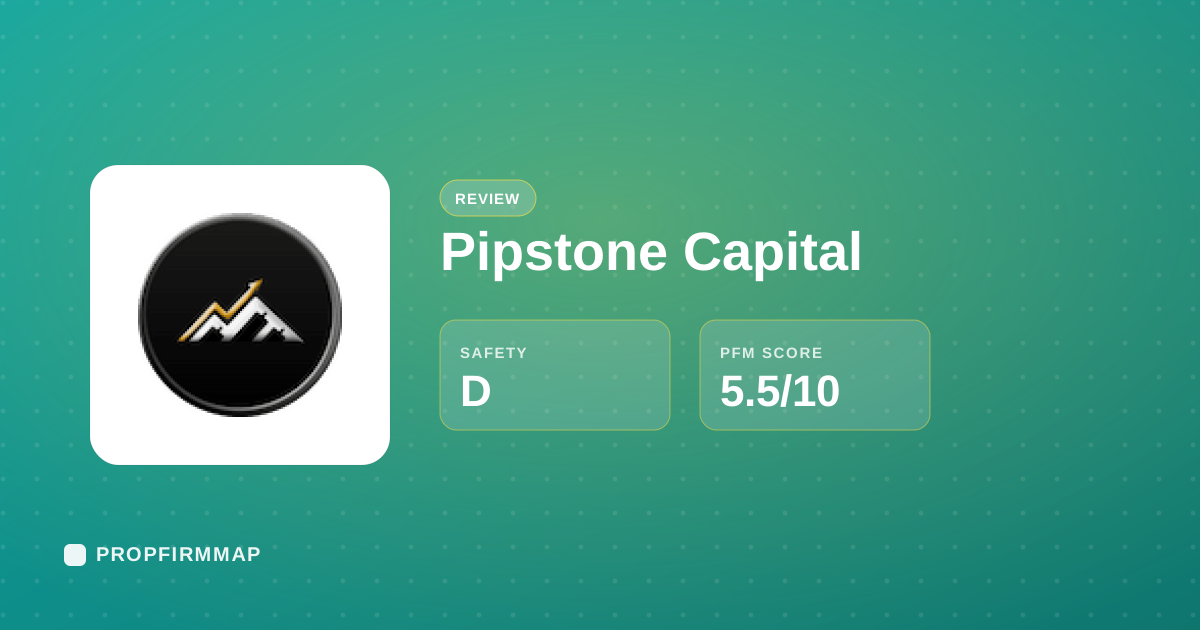
 Pipstone Capital is a proprietary trading firm registered in the United Arab Emirates that evaluates traders through funded-account challenges. It was founded in 2025 and lists a contact address in the U.A.E. along with a support address at [email protected]. The firm runs three separate evaluation models side by side: an Instant Funding account, a 1-Step Challenge, and a 2-Step Challenge. All three are traded on MetaTrader 5 and cTrader, and all three are advertised with no consistency rule.
This review is built from a live read of the firm's own challenges page and its Trustpilot profile, both checked on 13 August 2026. Where a number could not be confirmed, it is left out rather than estimated. One figure in particular could not be confirmed at all, and that finding is covered in detail below because it affects how you should read any price you see quoted for this firm anywhere.
The three models and their rules
Pipstone splits its offering into three products rather than selling one evaluation with variations. The rule sets differ meaningfully between them, so the model you pick matters more than the account size you pick. The table below reflects the firm's own challenges page as displayed on 13 August 2026.
| Rule | Instant Funding | 1-Step | 2-Step |
|---|---|---|---|
| Phase 1 profit target | No limit | 10% | 8% |
| Max daily loss | 3% | 4% | 5% |
| Max overall loss | 5% | 8% | 10% |
| Minimum trading days | 7 days | 3 days | 3 days |
| Leverage | 1:50 | 1:50 | 1:100 |
| Drawdown type | Trailing | Static | Static |
| Payout mode | On demand | Weekly / bi-weekly | Weekly / bi-weekly |
| Account sizes | $2.5K to $100K | $5K to $100K | $5K to $100K |
The Instant Funding account is the outlier in two respects. It carries no profit target at all, since there is no evaluation to pass, but it is also the only model with a trailing drawdown and the only one that requires seven minimum trading days instead of three. A trailing drawdown follows your account equity upward, so the loss limit tightens as you profit. On the 1-Step and 2-Step models the drawdown is static, meaning it stays fixed against the starting balance and does not move against you as the account grows.
On the evaluation models the dollar limits scale cleanly with account size. A 1-Step $50,000 account carries a $5,000 profit target, a $2,000 daily loss limit and a $4,000 overall loss limit. A 2-Step $50,000 account carries a $4,000 first-phase target, a $2,500 daily loss limit and a $5,000 overall loss limit, and requires a second phase before funding, recorded in our firm data at a 5% target. The 2-Step is the more forgiving of the two on loss limits and the 1-Step is the faster route, which is the usual trade-off between the two formats.
Profit split: read the add-ons line
Pipstone advertises "Up to 100% Reward Split" on every plan card. That phrasing is doing real work. The same challenges page states that when purchasing a challenge you have the option to include a bundle of add-ons, and it lists those add-ons as "100% Reward Split, Weekly Rewards, Free Account Reset". The 100% figure is therefore presented as a paid upgrade rather than the standard rate on a base account. The firm's own help-centre documentation, captured when we first onboarded this firm, describes the standard split as 80%.
Treat "up to 100%" as the ceiling of a paid add-on, not the rate you get by default. The documented standard split is 80%.
Other features listed on the plan cards include zero activation fee, unlimited trading days, no cap on withdrawals, and a stated average reward processing time of eight hours with a "2X reward upon delay" policy. News trading and holding over the weekend are permitted on the Instant model, and copy trading is listed as allowed. The 2-Step card additionally lists a refund of the evaluation fee on the first reward.
The pricing problem
We could not establish what Pipstone Capital charges, and that is a finding rather than a gap in our research.
The challenges page renders one plan card that updates as you click through model and account-size selectors. We enumerated all fifteen model and size combinations twice, minutes apart, from the same machine. Every rule field came back identical between the two reads: the same profit targets, the same daily and overall loss limits, the same minimum trading days, leverage, drawdown type and payout mode, down to the character. The price field did not. Thirteen of the fifteen prices differed between the two reads. The $25,000 Instant account displayed two different figures. So did the $5,000 2-Step account, the $50,000 1-Step account and ten others.
Pipstone's challenges page returned different prices for the same plan on two reads taken minutes apart, while every rule field stayed identical. We are not quoting a price for any plan because no single figure could be confirmed. Check the amount on the checkout page before you pay, and check it against what the plan card showed you.
We are not able to say from the outside whether this is a display animation being captured mid-update, a rotating promotional discount, or dynamic pricing. What we can say is that a price read from that page once is not reliable on its own. The page also carried a countdown-timed "buy one get one free" code and a separate percentage-off pop-up during our read, so more than one discount mechanism is active at the same time. If you are comparing this firm against another on cost, confirm the figure at the checkout step rather than from the plan card.
Trustpilot standing
Pipstone Capital holds a Trustpilot score of 2.2 out of 5 across 440 reviews, of which 435 were posted in the last twelve months. The profile is claimed, carries a paid Trustpilot subscription, and is listed under the Alternative Financial Service category. Trustpilot records that the company has replied to 20% of its negative reviews and typically replies within two weeks.
Trustpilot's own automatically generated summary of those reviews states that, evaluating 415 reviews, "most reviewers were unhappy with their experience overall" and that customers "frequently experienced severe delays and unfair rejections when trying to withdraw their earnings, often facing unexpected rule enforcement that blocked their profits entirely". The recurring themes Trustpilot identifies are payment and withdrawal handling and customer service. Positive reviews do exist on the profile, including reports of completed payouts, but they are the minority of recent feedback.
This matters more for a firm selling instant funding than it would elsewhere. An instant-funding product moves the risk forward: you pay up front and the firm's payout behaviour is the entire value you are buying, because there is no evaluation stage in between.
Pros and cons
Strengths
- Three genuinely distinct models under one account, so a trader can choose between instant funding, a single evaluation phase or a two-phase evaluation without switching firms.
- Static drawdown on both evaluation models, measured against the starting balance rather than trailing account equity.
- No consistency rule advertised on any model, with news trading and weekend holding permitted on the Instant product, and both MetaTrader 5 and cTrader supported.
Weaknesses
- A Trustpilot score of 2.2 from 440 reviews, with the platform's own summary reporting withdrawal delays and rejections as recurring themes.
- The headline 100% reward split is listed as a paid add-on rather than the standard rate, which is documented at 80%.
- Prices on the firm's own challenges page were not reproducible across two reads, so the cost of a plan cannot be confirmed before checkout.
How it compares
Set against established CFD firms in our database, the rule set is competitive and the reputation record is not. The comparison below uses Trustpilot standing and advertised profit split, the two measures available on a like-for-like basis.
| Firm | Trustpilot | Reviews | Advertised split |
|---|---|---|---|
| Pipstone Capital | 2.2 | 440 | Up to 100% (add-on) |
| FTMO | 4.8 | 42,594 | Up to 90% |
| The5ers | 4.7 | 28,714 | Up to 100% |
| Alpha Capital Group | 4.7 | 18,792 | 80% |
The gap in review volume is as relevant as the gap in score. FTMO, The5ers and Alpha Capital Group have each accumulated tens of thousands of reviews over several years, while Pipstone launched in 2025 and has gathered 440. A young firm with a low score has less history behind it than the number suggests, in both directions: the sample is thinner, but it is also concentrated almost entirely in the last twelve months, meaning it describes the firm as it operates now rather than as it operated years ago.
Verdict
Pipstone Capital's published rules are clear and, on the evaluation models, reasonable. Static drawdown, a 10% single-phase target, three minimum trading days and no consistency requirement are terms that compare well against the wider CFD market, and supporting both MetaTrader 5 and cTrader is more than many firms of this age offer.
The concerns are not about the rules as written but about the two things a trader cannot verify in advance: what the account will actually cost, and whether profits will be paid without dispute. On the first, the firm's own pricing display was not reproducible across two reads. On the second, Trustpilot's aggregate record across 440 reviews points to withdrawal handling as the dominant complaint.
This firm may suit a trader who wants a static-drawdown evaluation with no consistency rule on MetaTrader 5 or cTrader, who is committing an amount they are prepared to lose outright, and who has confirmed the checkout price directly before paying. Traders whose main criterion is a documented payout record should weigh the Trustpilot standing carefully against the alternatives above before committing funds.
Sources checked 13 August 2026: pipstonecapital.com/challenges (all fifteen model and account-size combinations, read twice) and trustpilot.com/review/pipstonecapital.com. Profit split documentation from the firm's help centre, captured at onboarding. No price figure is quoted in this review because none could be reproduced across repeat reads.
See also: Sway Funded - CFD prop firm, Rapid, Regular and Instant programs with accounts from $1,000 to $200,000 and entry from $10.
See also: Capital Mint Markets - UAE CFD prop firm, six programmes from $9.99 with static drawdown on three of its five permanent programmes.
See also: Pipcy - CFD prop firm with no daily loss limit and a 12% absolute maximum loss.
See also: Paid To Trade - CFD prop firm, static drawdown with no consistency rule on Static and Instant accounts.
See also: Pivex Funded - CFD prop firm, one-step Match Trader challenge sold as a one-time fee or a monthly membership.
Explore More
Related Articles