PropMarket Review: Plans, Rules, and How It Compares
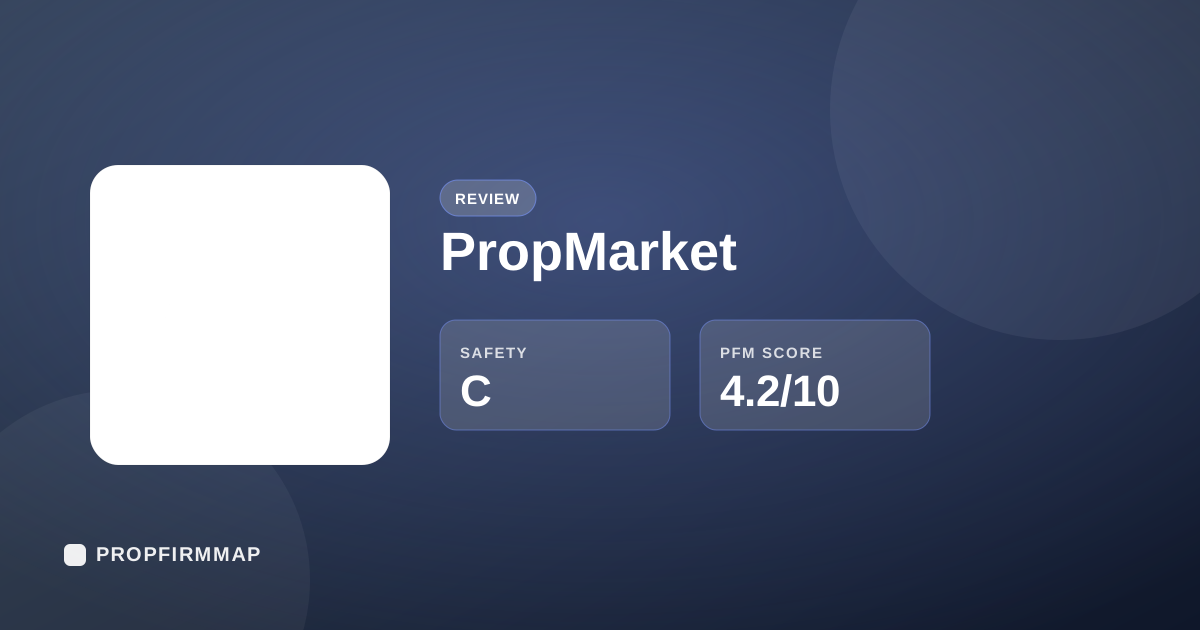
 PropMarket is a United States based proprietary trading firm that funds traders on prediction markets rather than on forex, futures or equities. It describes itself on its homepage as "The World's First Prediction Market Prop Firm" and funds accounts traded on Polymarket and Kalshi. The firm launched on 15 May 2026. Instead of buying and selling currency pairs or index futures, a PropMarket trader takes positions on event contracts: politics, economics, sports, crypto, weather and culture markets that resolve to yes or no. The commercial model is familiar even if the instrument is not. You buy a one-time evaluation, hit a profit target inside a time limit without breaching a drawdown rule, and you are given a funded account with a share of the profits.
Plans and pricing
PropMarket sells one product, called The Evaluation, in five account sizes. It is a single-step evaluation: there is no Phase 1 and Phase 2. The fee is one-time and the firm states "No activation fee" on the pricing card, so the advertised price is the full cost of an attempt. Every size carries identical rules, which the firm confirms in its own FAQ: the same 20% profit target, 10% max drawdown, 70/30 profit split and 30-day time limit apply from the $5K account to the $100K account.
| Account size | One-time fee | Profit target | Max drawdown | Time limit |
|---|---|---|---|---|
| $5K | $59 | 20% | 10% | 30 days |
| $10K | $119 | 20% | 10% | 30 days |
| $25K | $279 | 20% | 10% | 30 days |
| $50K | $549 | 20% | 10% | 30 days |
| $100K | $1,099 | 20% | 10% | 30 days |
A $250K tier appears on the pricing page under a "Coming Soon" heading. It is not purchasable today: the firm states that passing one of the existing evaluations earns early access to a waitlist for the $250K funded account. The homepage headline advertises funding "with up to $250,000 in capital", so it is worth being clear that $100K is the largest account a trader can actually buy at the moment.
Three optional add-ons are published on the same card, priced as a percentage uplift on the evaluation fee: a profit split upgrade to 90/10 at +30%, a consistency threshold raised from 10% to 20% at +80%, and Double Time, which allows 60 days instead of 30, at +10%.
PropMarket asks for a 20% return in 30 days. That is a demanding target, and it is the trade-off for the rule most traders will notice first: there is no daily loss limit at all, so a single bad session cannot end the account on its own.
Rules and how the account can be lost
The single risk rule is a 10% Max Drawdown calculated as a trailing equity high-water mark. The firm's own tooltip states that it "tracks from your highest equity point, not starting balance", and its FAQ confirms the calculation is equity-based, so the value of open positions counts and the threshold trails upward as the account makes new highs. It applies across both the evaluation and the funded account. There is no daily drawdown: the pricing card lists Daily Drawdown as "None" and states that only total drawdown applies.
A 10% consistency rule applies per market, meaning no single market may account for more than 10% of total profit. Usefully, the firm documents that exceeding it is not an instant breach. Its FAQ explains that the profit requirement instead adjusts upward until the largest trade falls back inside the 10% range, so a trader continues trading to rebalance rather than losing the account.
Two eligibility rules narrow which contracts can be traded. Markets must be priced between 20 and 80 cents, and they must resolve within 60 days. There are no category restrictions beyond that, so any market on Polymarket or Kalshi that satisfies the price and resolution window is fair game. An inactivity limit closes the account if no trades are placed for 30 days.
On payouts, PropMarket publishes a 7-day wait for the first withdrawal and 7 days between payouts thereafter, with a minimum of 2% profit required before a withdrawal can be requested. Funded accounts drop the profit target and the time limit; the drawdown, consistency, inactivity and market eligibility rules all carry over.
Pros and cons
Pros
- No daily loss limit. Only the 10% total drawdown applies, so a single losing day cannot breach the account by itself.
- A one-time fee with no activation fee, starting at $59, and a single-step evaluation rather than two phases.
- Breaching the consistency threshold adjusts the profit requirement upward rather than failing the account outright, which the firm documents in writing.
Cons
- The 10% drawdown is a trailing equity high-water mark that also applies on the funded account, so profits raise the level at which the account breaches.
- Tradable contracts are limited to the 20 to 80 cent price band and a 60-day resolution window, which excludes low-priced longshots and long-dated events.
- The firm is an affiliate of Prop Account, LLC, which is the counterparty on every funding assessment, and its TrustPilot profile is unclaimed with a single review, so there is very little independent payout evidence yet.
PropMarket's TrustPilot profile carries a 3.7 score from exactly one review, a 5-star review posted on 29 May 2026, and the profile is unclaimed. TrustPilot also notes the company has no history of asking for reviews. One review is not a payout track record either way. Treat the firm as unproven on withdrawals until more traders report.
How PropMarket compares
Direct comparison is awkward because very few funded-trading firms operate on prediction markets at all. The closest peer we list is Funding Predicts, which also funds Polymarket traders and is backed by MyFundedFutures. Alongside it, two crypto firms in the same entry-price band give a sense of what $59 to $99 buys elsewhere.
| PropMarket | Funding Predicts | HyroTrader | Hash Hedge | |
|---|---|---|---|---|
| Markets | Polymarket, Kalshi | Polymarket | Crypto (Bybit, Cleo) | Crypto and real-world assets |
| Lowest entry fee | $59 ($5K) | $85 ($10K) | $59 (5,000 USDT, two-step) | $79 (2-Stage) |
| Profit target | 20% | $600 on the $10K Challenge | 10% | 8% (2-Stage) |
| Max drawdown | 10%, trailing equity HWM | $300 on the $10K Challenge, trailing EOD | 6% of initial balance | 10% (2-Stage) |
| Daily loss limit | None | $200 on the $10K Challenge | 4% | 5% (2-Stage) |
| Profit split | 70 / 30, upgradeable to 90 / 10 | 80-90% | 80% scaling to 90% | Not recorded |
| TrustPilot | 3.7 (1 review) | 4.7 (46 reviews) | 4.2 (239 reviews) | 4.5 (114 reviews) |
Two differences stand out. PropMarket's 20% profit target is the most demanding of the four, and its 10% drawdown is the most permissive, which is a coherent pairing: more room to be wrong, but more required to pass. Against Funding Predicts specifically, the structural gap is the daily loss limit. Funding Predicts caps a single day at $200 on its $10K Challenge and uses a trailing end-of-day drawdown, while PropMarket imposes no daily cap and marks its drawdown against live equity including open positions. Neither is straightforwardly gentler: an intraday swing that would never register on an end-of-day calculation can breach an equity-based one.
On evidence, PropMarket is the newest and least reviewed of the four by a wide margin. Funding Predicts, HyroTrader and Hash Hedge each carry between 46 and 239 TrustPilot reviews against PropMarket's single review.
A 20% target with no daily loss limit is a different game from a 10% target with a 4% daily cap. Pick the constraint you actually trade against.PropFirmMap
Verdict
PropMarket is a coherent product for a specific trader: someone who already trades event contracts on Polymarket or Kalshi, is comfortable with a 20% return objective inside 30 days, and values the absence of a daily loss limit more than a lower profit target. The rules are unusually well documented for a firm this new, and the consistency rule in particular is written to keep an account alive rather than to fail it. The pricing is transparent, with no activation fee and no second phase.
The reasons for caution are the firm's age and its evidence base. It launched in May 2026, it carries one TrustPilot review, its profile is unclaimed, and all funding assessments are contracted through Prop Account, LLC rather than PropMarket itself. Traders who want a documented payout history before committing capital should wait for one to accumulate. Traders who want to be early on prediction-market funding, and who can accept an unproven withdrawal record, will find the terms clearly stated and the entry cost low.
All figures in this review were verified against prop.market and the firm's TrustPilot profile on 3 September 2026. Prop firm terms change frequently: check the firm's own pricing page before purchasing.
Explore More
Related Articles